Lesson 16 · 16 of 20
Namespaces and enum class · C++
Organise C++ code with namespaces, aliases and using, and use enum class for safe named states: the steps of an online order.
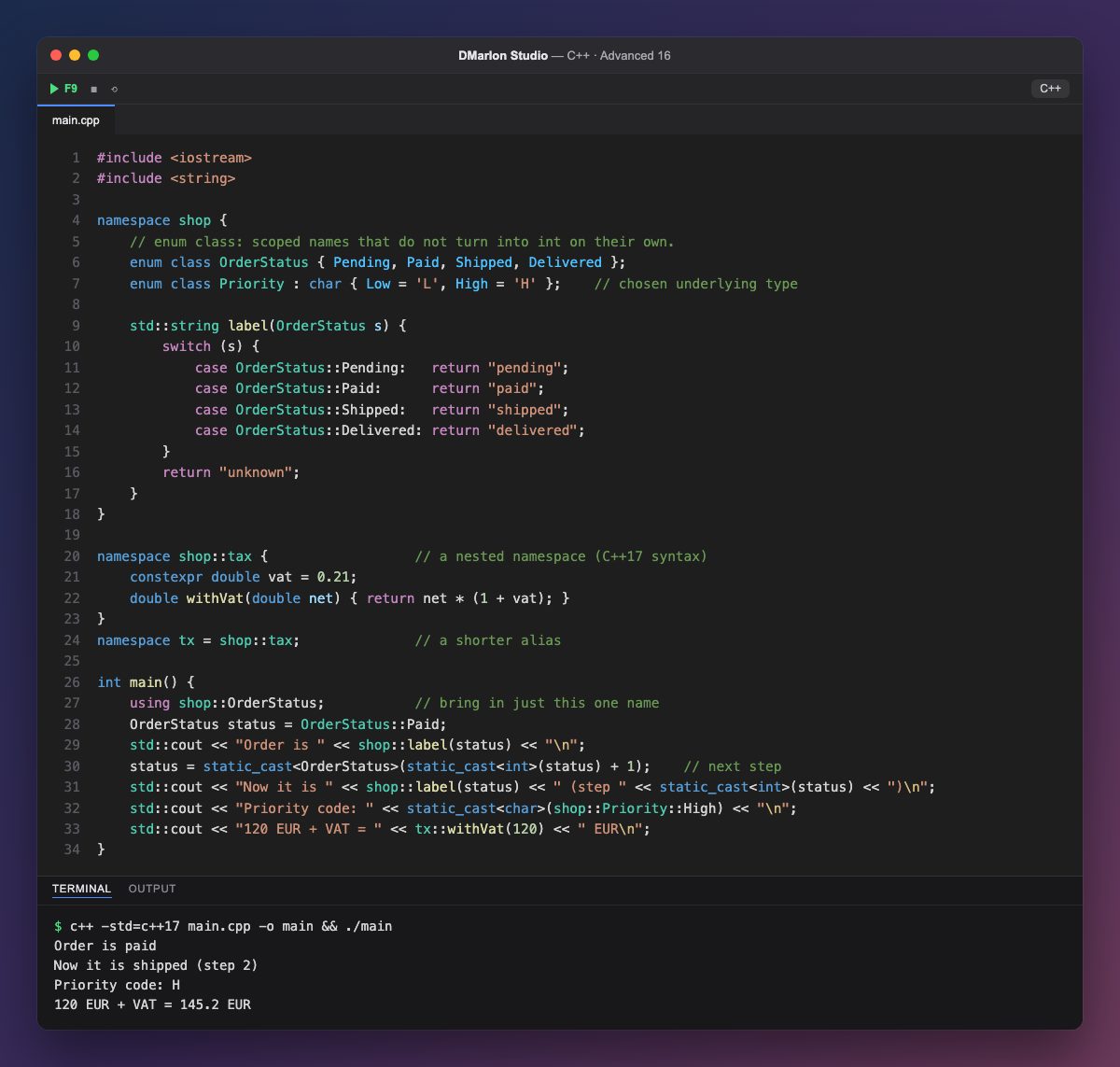
A namespace groups names so they do not clash with names from other parts of the program or other libraries: shop::label cannot be confused with any other label. That is what std:: does for the whole standard library. From outside, you use the full name with ::.
Since C++17, namespace shop::tax opens a nested namespace in a single line, and namespace tx = shop::tax; creates a shorter alias. using shop::OrderStatus; brings just that one name into main's block, which is safer than pulling in a whole namespace with using namespace.
`enum class` defines a type with named values. Unlike the classic enum, its names live inside the type (OrderStatus::Paid) and do not turn into integers on their own: status == 2 would not compile. Moving to the next step needs a deliberate conversion, static_cast<int> and back with static_cast<OrderStatus>; values start at 0, so "shipped" is step 2.
You can also choose the underlying type: Priority : char stores each value as a character, 'L' or 'H'. The switch in label covers every status; add a new one and forget it here, and -Wall will warn you. constexpr double vat is a constant the compiler knows in advance, as you will see in lesson 19.
Code · main.cpp
#include <iostream>#include <string>namespace shop { // enum class: scoped names that do not turn into int on their own. enum class OrderStatus { Pending, Paid, Shipped, Delivered }; enum class Priority : char { Low = 'L', High = 'H' }; // chosen underlying type std::string label(OrderStatus s) { switch (s) { case OrderStatus::Pending: return "pending"; case OrderStatus::Paid: return "paid"; case OrderStatus::Shipped: return "shipped"; case OrderStatus::Delivered: return "delivered"; } return "unknown"; }}namespace shop::tax { // a nested namespace (C++17 syntax) constexpr double vat = 0.21; double withVat(double net) { return net * (1 + vat); }}namespace tx = shop::tax; // a shorter aliasint main() { using shop::OrderStatus; // bring in just this one name OrderStatus status = OrderStatus::Paid; std::cout << "Order is " << shop::label(status) << "\n"; status = static_cast<OrderStatus>(static_cast<int>(status) + 1); // next step std::cout << "Now it is " << shop::label(status) << " (step " << static_cast<int>(status) << ")\n"; std::cout << "Priority code: " << static_cast<char>(shop::Priority::High) << "\n"; std::cout << "120 EUR + VAT = " << tx::withVat(120) << " EUR\n";}Output · c++ -std=c++17 main.cpp -o main && ./main
Order is paid
Now it is shipped (step 2)
Priority code: H
120 EUR + VAT = 145.2 EUR
Key points
namespace name { ... }groups code; use it asname::thing.namespace a::bnests andnamespace x = a::b;makes an alias.using a::thing;brings in one name; avoidusing namespacein headers.enum classdoes not mix with integers without astatic_cast.enum class E : charchooses the type used for storage.
Exercise
Add a Cancelled status to OrderStatus, compile to see the switch warning, and complete label so it returns "cancelled".