Lesson 8 · 8 of 20
Booleans and comparisons · Pascal
Compare values in Pascal with =, <>, < and >, and combine conditions with and, or, not and xor to decide who rides the roller coaster.
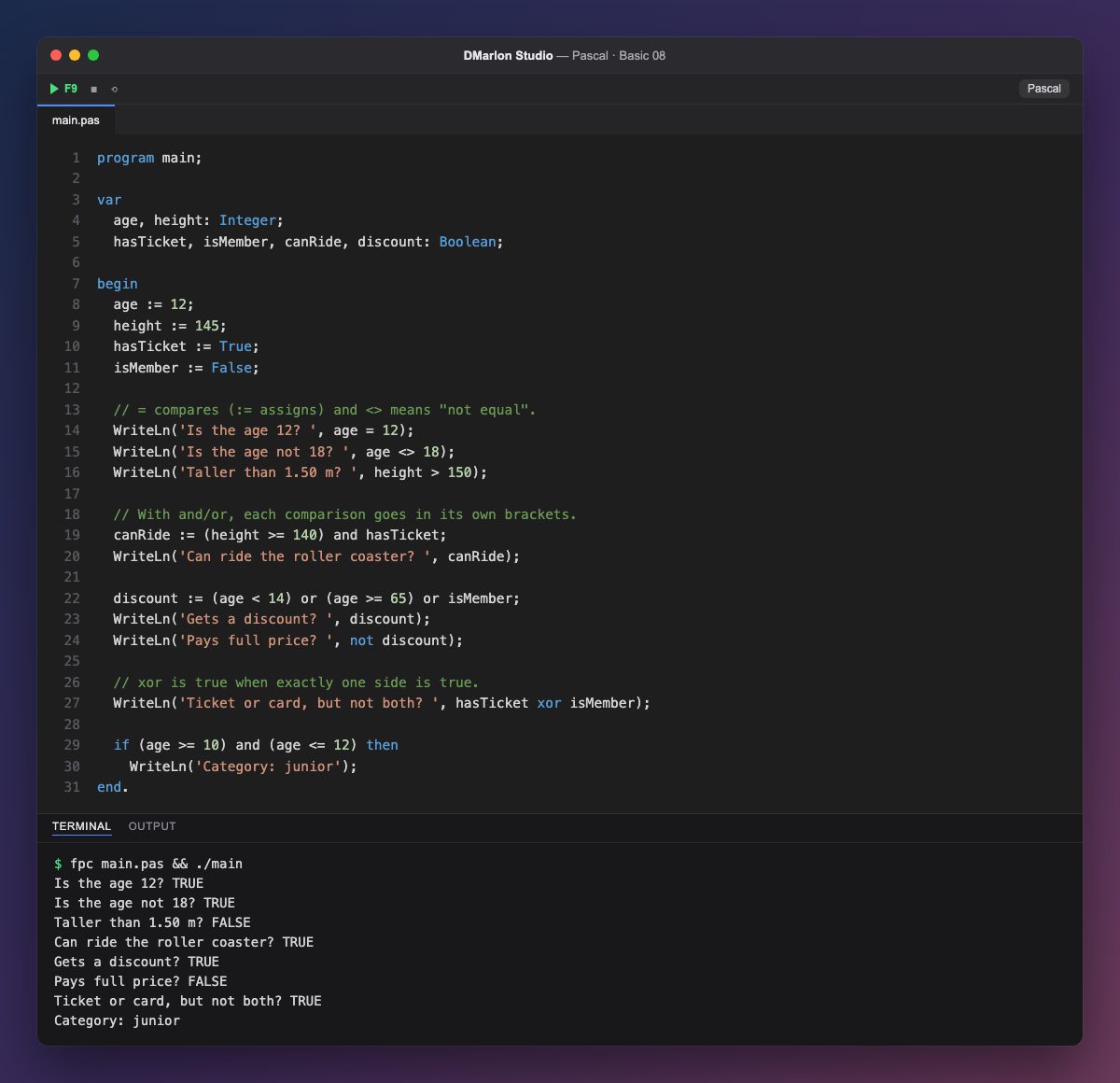
A comparison gives a `Boolean`: True or False, which WriteLn prints as TRUE and FALSE. The operators are =, <> (not equal), <, >, <= and >=. Remember: = compares and := assigns.
Conditions are combined with `and` (both must hold), `or` (one is enough) and `not` (turns it around). The result can be stored in a variable, such as canRide or discount, and used later.
The key point: in Pascal, and and or have higher precedence than comparisons, so each comparison needs its own brackets: (height >= 140) and hasTicket. Without them, age < 14 or age >= 65 would be read as age < (14 or age) >= 65 and would not compile.
`xor` is true when exactly one side is true. Free Pascal also uses short-circuit evaluation for and and or: if the first side already decides the result, the second is not checked.
(age >= 10) and (age <= 12) checks that the age falls within a range, the most common use inside an if.
Code · main.pas
program main;var age, height: Integer; hasTicket, isMember, canRide, discount: Boolean;begin age := 12; height := 145; hasTicket := True; isMember := False; // = compares (:= assigns) and <> means "not equal". WriteLn('Is the age 12? ', age = 12); WriteLn('Is the age not 18? ', age <> 18); WriteLn('Taller than 1.50 m? ', height > 150); // With and/or, each comparison goes in its own brackets. canRide := (height >= 140) and hasTicket; WriteLn('Can ride the roller coaster? ', canRide); discount := (age < 14) or (age >= 65) or isMember; WriteLn('Gets a discount? ', discount); WriteLn('Pays full price? ', not discount); // xor is true when exactly one side is true. WriteLn('Ticket or card, but not both? ', hasTicket xor isMember); if (age >= 10) and (age <= 12) then WriteLn('Category: junior');end.Output · fpc main.pas && ./main
Is the age 12? TRUE
Is the age not 18? TRUE
Taller than 1.50 m? FALSE
Can ride the roller coaster? TRUE
Gets a discount? TRUE
Pays full price? FALSE
Ticket or card, but not both? TRUE
Category: junior
Key points
- Comparisons give
TrueorFalse. <>means «not equal to».and,or,notandxorcombine Booleans.- Put each comparison in brackets when using
andoror.
Exercise
Add a withAdult: Boolean variable and change canRide so children under 8 can only ride with an adult: (height >= 140) and hasTicket and ((age >= 8) or withAdult).