Lesson 12 · 12 of 20
Tuples and unpacking · Python
Use Python tuples for data that does not change, and unpack them into several variables at once, even inside a for loop.
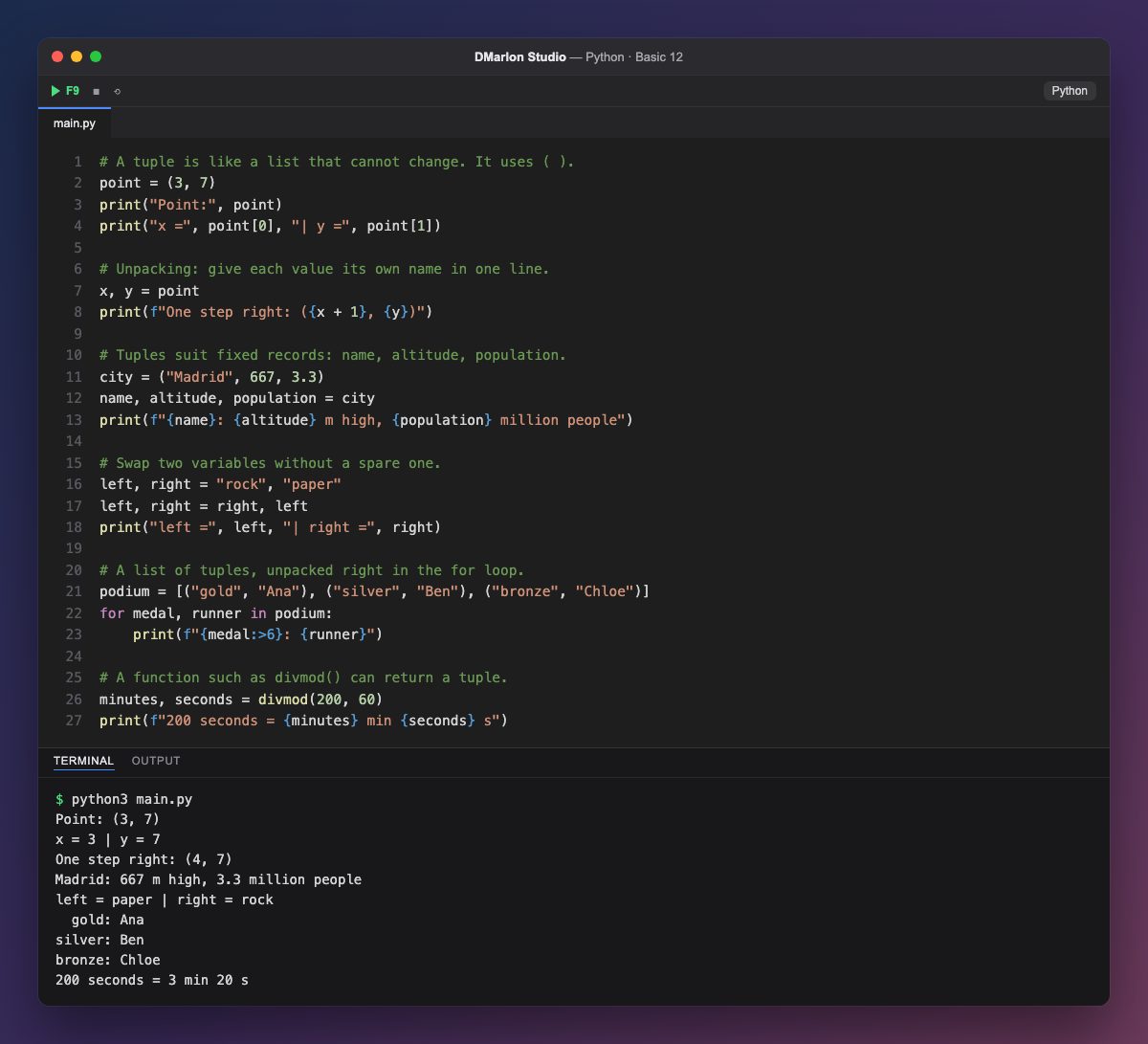
A tuple is like a list, but between parentheses and impossible to change once it is created. It suits data that belongs together and stays fixed, such as a point (3, 7): you read its values as in a list, point[0] and point[1].
Unpacking hands out the values of a tuple to several variables in one line: x, y = point leaves x = 3 and y = 7. You need as many variables as values; the city works the same way, with name, altitude and population.
The same trick swaps two variables without a spare one: left, right = right, left. Python first builds the tuple on the right and then hands it out.
A list of tuples is very handy for tables. In for medal, runner in podium: each round receives one tuple and unpacks it into medal and runner; {medal:>6} lines up the medals on the right.
Some functions return a tuple. divmod(200, 60) gives the floor division and the remainder at once, (3, 20): 200 seconds are 3 minutes and 20 seconds.
Code · main.py
# A tuple is like a list that cannot change. It uses ( ).point = (3, 7)print("Point:", point)print("x =", point[0], "| y =", point[1])# Unpacking: give each value its own name in one line.x, y = pointprint(f"One step right: ({x + 1}, {y})")# Tuples suit fixed records: name, altitude, population.city = ("Madrid", 667, 3.3)name, altitude, population = cityprint(f"{name}: {altitude} m high, {population} million people")# Swap two variables without a spare one.left, right = "rock", "paper"left, right = right, leftprint("left =", left, "| right =", right)# A list of tuples, unpacked right in the for loop.podium = [("gold", "Ana"), ("silver", "Ben"), ("bronze", "Chloe")]for medal, runner in podium: print(f"{medal:>6}: {runner}")# A function such as divmod() can return a tuple.minutes, seconds = divmod(200, 60)print(f"200 seconds = {minutes} min {seconds} s")Output · python3 main.py
Point: (3, 7)
x = 3 | y = 7
One step right: (4, 7)
Madrid: 667 m high, 3.3 million people
left = paper | right = rock
  gold: Ana
silver: Ben
bronze: Chloe
200 seconds = 3 min 20 s
Key points
- A tuple goes between
( )and cannot be changed. a, b = some_tuplehands its values out to variables.a, b = b, aswaps two variables.- A
forloop can unpack each tuple of a list.
Exercise
Make a list of tuples with three cities (name, today's temperature) and print each one with its temperature; then swap the first and the last city.