Lesson 18 · 18 of 20
Enums and typedef · C
Name fixed values with enum in C and create short type names with typedef: a traffic light and the orders at a coffee shop.
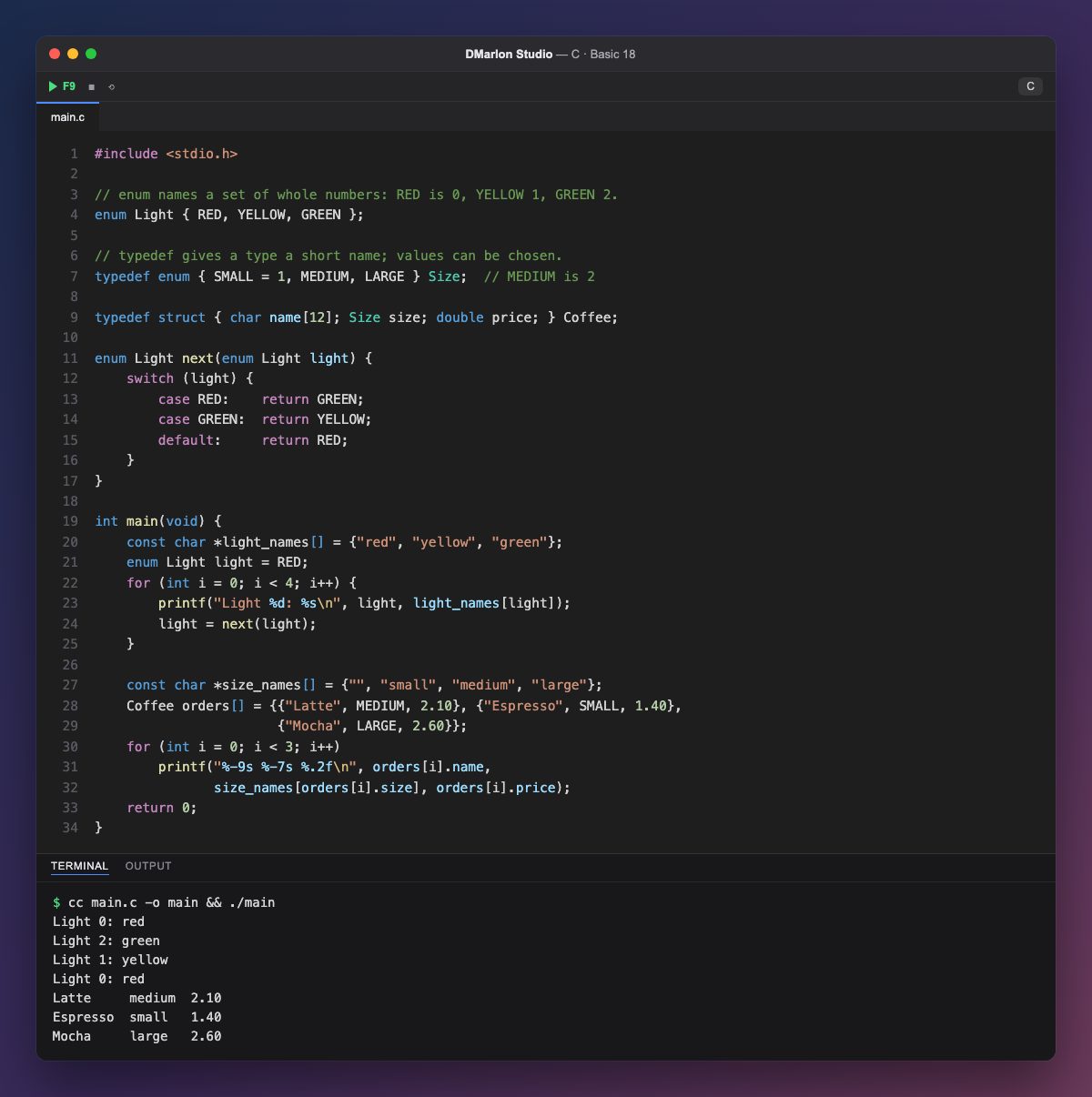
An `enum` gives names to a set of whole numbers. In enum Light { RED, YELLOW, GREEN }, RED is 0, YELLOW is 1 and GREEN is 2. Code reads better with RED than with a bare 0, and the compiler can warn you when a switch misses a case.
next uses a switch on the enum to follow the traffic light's order: red, green, yellow and back to red. Since the values are numbers, they also work as indexes: light_names[light] looks up the name in an array of strings.
You can choose the values: in SMALL = 1, MEDIUM, LARGE, the following ones carry on counting, so MEDIUM is 2 and LARGE is 3. That is why size_names starts with an empty string at position 0.
`typedef` gives a type another name. Thanks to it you write Size instead of enum ... and Coffee instead of struct .... The struct for Coffee is declared on a single line, and the orders array holds three orders, which the for prints in columns.
Code · main.c
#include <stdio.h>// enum names a set of whole numbers: RED is 0, YELLOW 1, GREEN 2.enum Light { RED, YELLOW, GREEN };// typedef gives a type a short name; values can be chosen.typedef enum { SMALL = 1, MEDIUM, LARGE } Size; // MEDIUM is 2typedef struct { char name[12]; Size size; double price; } Coffee;enum Light next(enum Light light) { switch (light) { case RED: return GREEN; case GREEN: return YELLOW; default: return RED; }}int main(void) { const char *light_names[] = {"red", "yellow", "green"}; enum Light light = RED; for (int i = 0; i < 4; i++) { printf("Light %d: %s\n", light, light_names[light]); light = next(light); } const char *size_names[] = {"", "small", "medium", "large"}; Coffee orders[] = {{"Latte", MEDIUM, 2.10}, {"Espresso", SMALL, 1.40}, {"Mocha", LARGE, 2.60}}; for (int i = 0; i < 3; i++) printf("%-9s %-7s %.2f\n", orders[i].name, size_names[orders[i].size], orders[i].price); return 0;}Output · cc main.c -o main && ./main
Light 0: red
Light 2: green
Light 1: yellow
Light 0: red
Latte     medium  2.10
Espresso  small   1.40
Mocha     large   2.60
Key points
enumnames whole-number values: the first is 0.- You can set a value,
SMALL = 1; the next ones carry on. - An
enumworks well in aswitchand as an index. typedefcreates a short name for a type.- With
typedef struct { ... } Name;you no longer writestruct.
Exercise
Add an enum Milk { WHOLE, SKIMMED, OAT } and a milk field in Coffee, and print each order's milk too.