Lesson 9 · 9 of 20
for loops · C
Use C's for loop to count up and down, add things up, skip turns with continue, leave with break and nest one loop inside another.
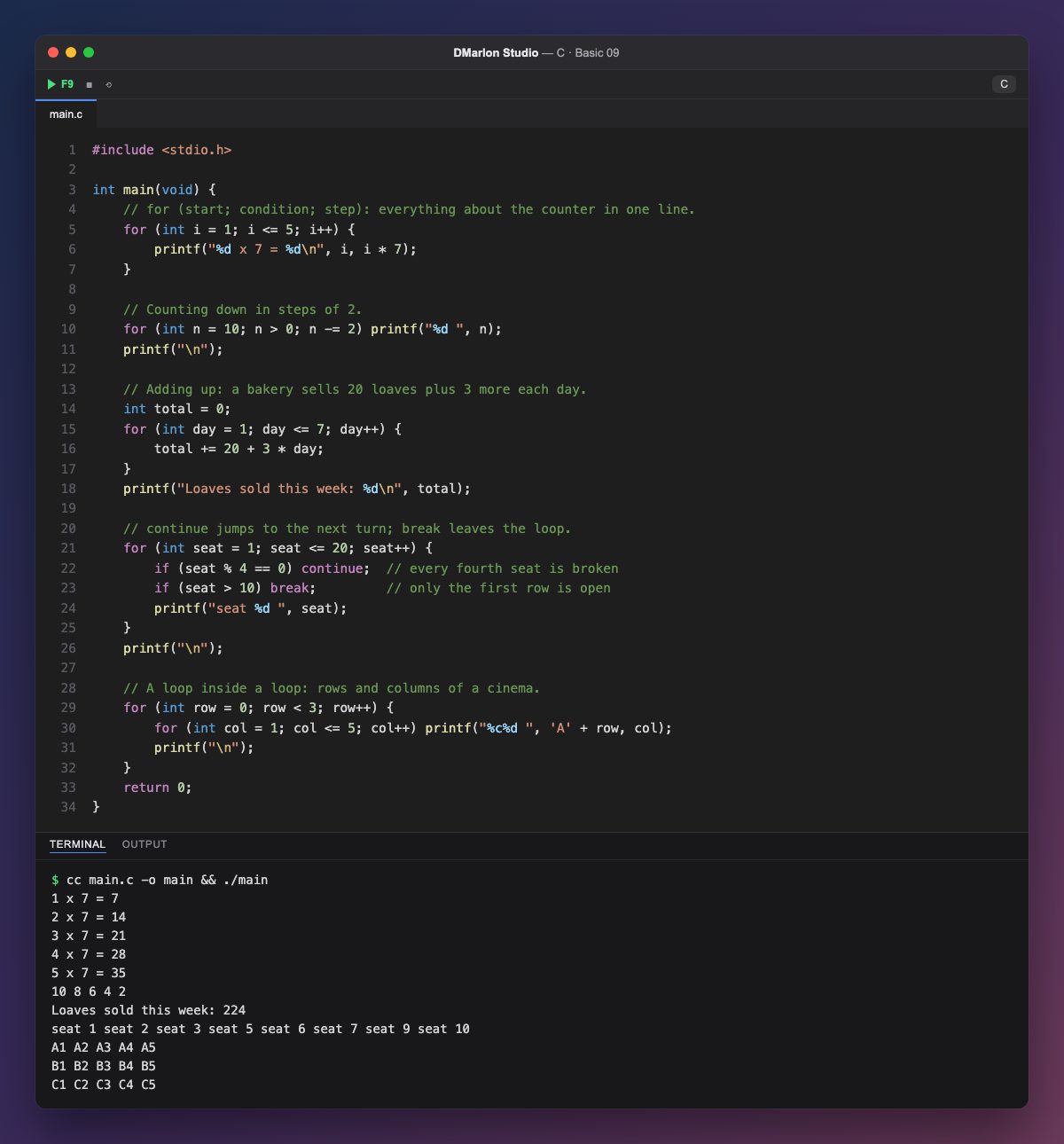
`for` puts the three parts of a counting loop in one line: the start (int i = 1), the condition (i <= 5) and the step (i++). It does the same as a while, but more compactly. The variable i only exists inside the loop.
The step can be anything: n -= 2 counts down in twos. A for is also good for adding up: total starts at 0 and every day adds that day's sales, 20 + 3 * day, reaching 224 loaves.
`continue` jumps to the end of the turn and moves on to the next: seats that are multiples of 4 (seat % 4 == 0) are not printed. `break` leaves the loop altogether: once past seat 10 the loop ends, even though the condition goes up to 20.
A loop inside another goes through rows and columns. For each row, the inner loop runs five times. 'A' + row takes advantage of a char being a number: 'A' + 1 is 'B'.
Code · main.c
#include <stdio.h>int main(void) { // for (start; condition; step): everything about the counter in one line. for (int i = 1; i <= 5; i++) { printf("%d x 7 = %d\n", i, i * 7); } // Counting down in steps of 2. for (int n = 10; n > 0; n -= 2) printf("%d ", n); printf("\n"); // Adding up: a bakery sells 20 loaves plus 3 more each day. int total = 0; for (int day = 1; day <= 7; day++) { total += 20 + 3 * day; } printf("Loaves sold this week: %d\n", total); // continue jumps to the next turn; break leaves the loop. for (int seat = 1; seat <= 20; seat++) { if (seat % 4 == 0) continue; // every fourth seat is broken if (seat > 10) break; // only the first row is open printf("seat %d ", seat); } printf("\n"); // A loop inside a loop: rows and columns of a cinema. for (int row = 0; row < 3; row++) { for (int col = 1; col <= 5; col++) printf("%c%d ", 'A' + row, col); printf("\n"); } return 0;}Output · cc main.c -o main && ./main
1 x 7 = 7
2 x 7 = 14
3 x 7 = 21
4 x 7 = 28
5 x 7 = 35
10 8 6 4 2
Loaves sold this week: 224
seat 1 seat 2 seat 3 seat 5 seat 6 seat 7 seat 9 seat 10
A1 A2 A3 A4 A5
B1 B2 B3 B4 B5
C1 C2 C3 C4 C5
Key points
for (start; condition; step)holds the whole counter.- An accumulator starts at 0 and adds on every turn.
continuemoves to the next turn;breakleaves the loop.- Nested loops go through rows and columns.
Exercise
Print the full 1 to 9 times table with two nested for loops, each number in a column 3 characters wide (%3d).