Lesson 8 · 8 of 20
For loops · Go
Repeat code in Go with for, the language's only loop: the classic form, as a while, with no condition at all, break and continue.
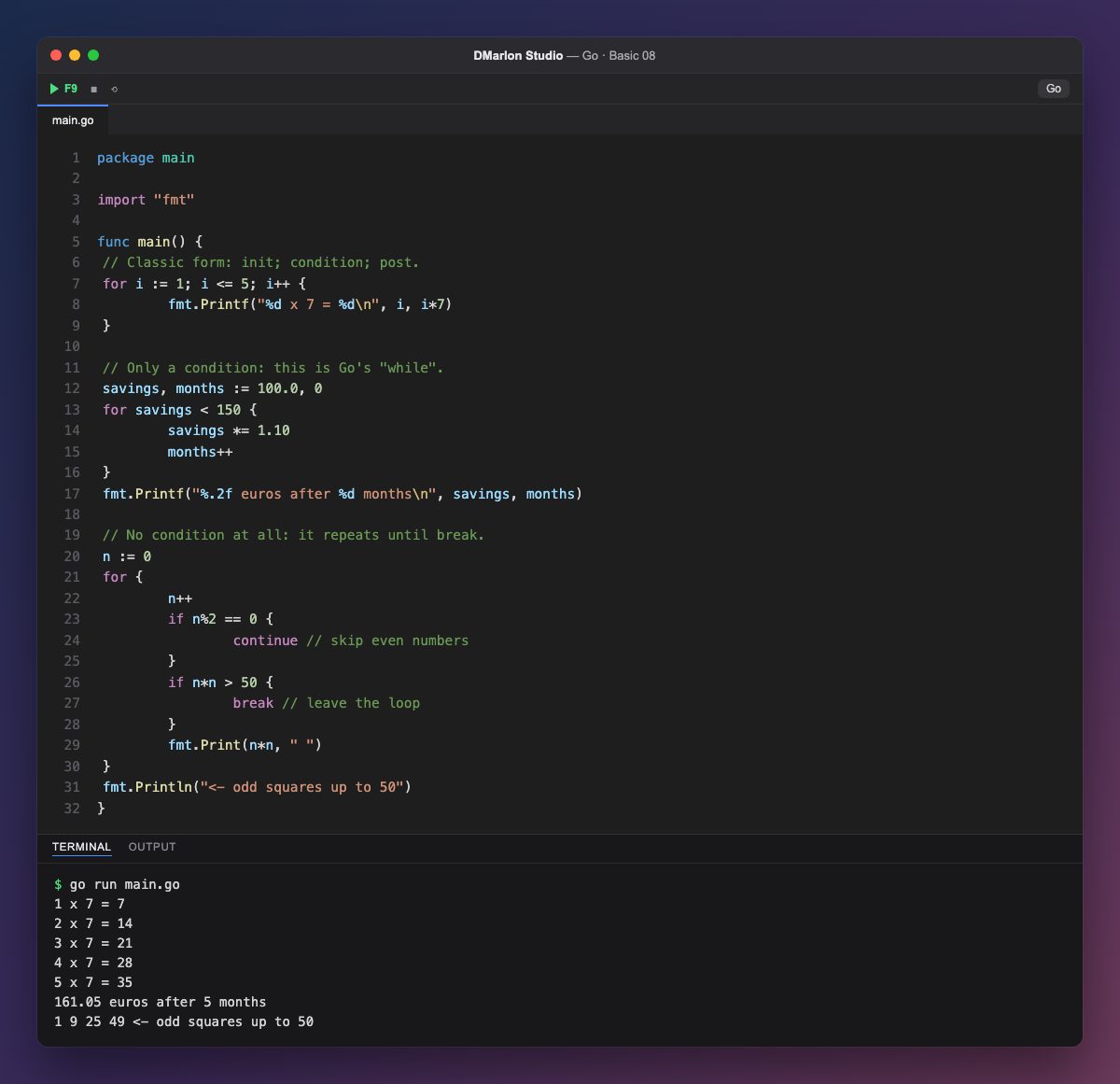
Go has a single loop, for, which does the job of all the others. The classic form has three parts separated by semicolons: i := 1 runs at the start, i <= 5 is checked before each turn and i++ runs at the end of each one. That gives the 7 times table from 1 to 5.
With only a condition, for is the while of other languages: for savings < 150 repeats as long as the savings have not reached 150. They grow 10% a month (savings *= 1.10) and months++ keeps count: it takes 5 months.
With no condition, for { } repeats forever, so you leave it with `break`. `continue` jumps straight to the next turn: here it skips the even numbers. The loop prints the squares of the odd ones, 1 9 25 49, and stops as soon as a square goes over 50.
fmt.Print(n*n, " ") prints each number followed by a space on the same line, and the final Println closes the line with an explanation.
Code · main.go
package mainimport "fmt"func main() { // Classic form: init; condition; post. for i := 1; i <= 5; i++ { fmt.Printf("%d x 7 = %d\n", i, i*7) } // Only a condition: this is Go's "while". savings, months := 100.0, 0 for savings < 150 { savings *= 1.10 months++ } fmt.Printf("%.2f euros after %d months\n", savings, months) // No condition at all: it repeats until break. n := 0 for { n++ if n%2 == 0 { continue // skip even numbers } if n*n > 50 { break // leave the loop } fmt.Print(n*n, " ") } fmt.Println("<- odd squares up to 50")}Output · go run main.go
1 x 7 = 7
2 x 7 = 14
3 x 7 = 21
4 x 7 = 28
5 x 7 = 35
161.05 euros after 5 months
1 9 25 49 <- odd squares up to 50
Key points
foris Go's only loop.for init; condition; post { }is the classic form.for condition { }works like a while.for { }repeats until abreak.continuemoves on to the next turn.
Exercise
Write a classic for that counts down from 10 to 1 (with i--) and, with a condition-only for, find how many times you can halve 1000 before it drops below 1.