Lesson 11 · 11 of 20
Maps · Go
Store key-value pairs in a Go map: adding, reading with ok, delete and len, and printing it in the same order every time with sort.Strings.
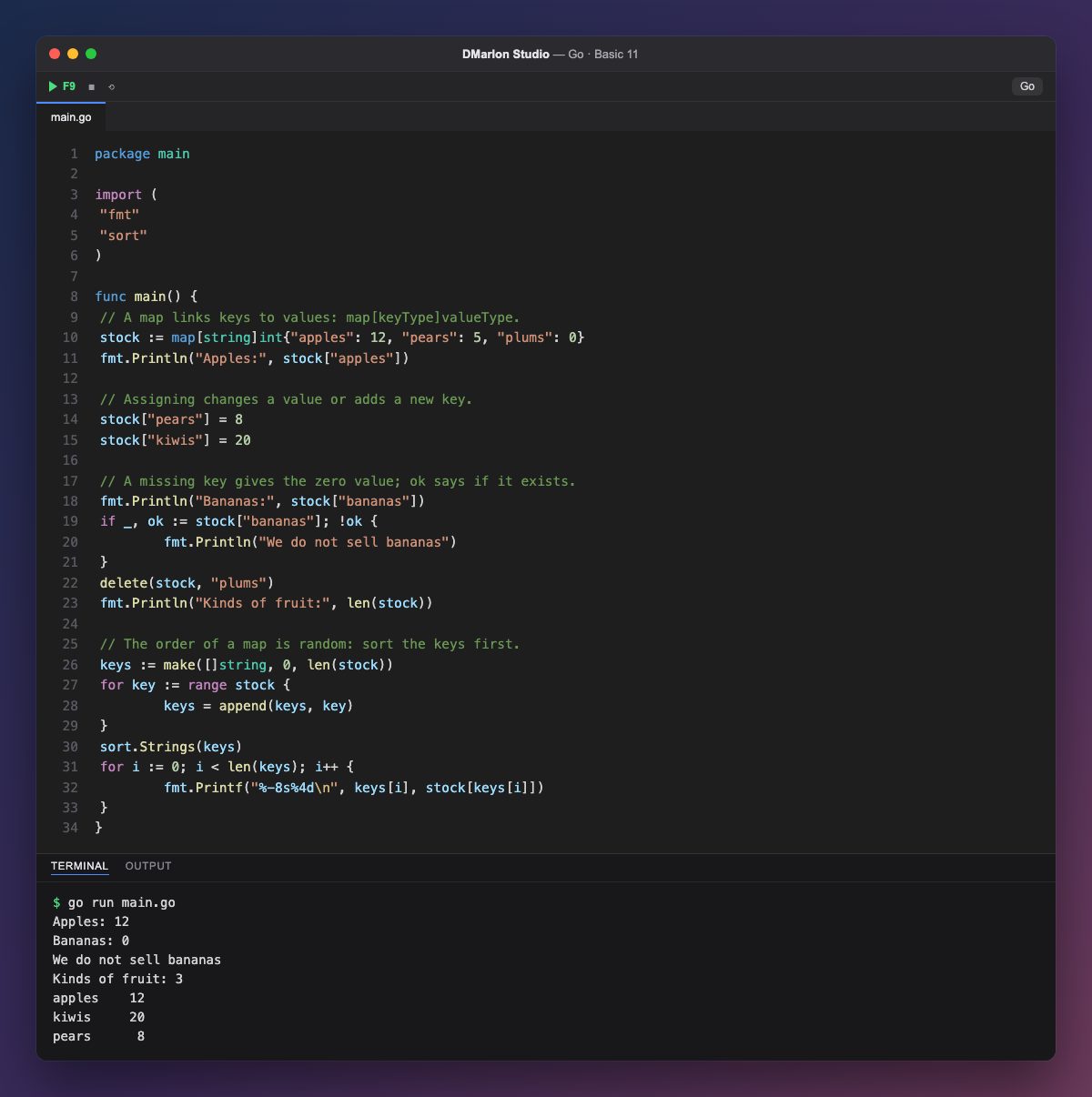
A map links keys to values. map[string]int has string keys and integer values, and the literal pairs them with a colon: "apples": 12. To read, put the key in square brackets: stock["apples"] gives 12.
Assigning to a key changes its value if it exists (pears becomes 8) and creates it if it does not (kiwis). Reading a missing key does not fail: it gives the type's zero value, 0. To find out whether it is really there, ask for a second value: _, ok := stock["bananas"] leaves ok as false.
delete(stock, "plums") removes a key together with its value, and len(stock) counts the ones left: 3.
The order of a Go map is random on purpose: each run may walk it differently. To print it the same way every time, gather the keys into a slice with for key := range stock (lesson 18 covers range), sort them with sort.Strings(keys) and go through them in that order, reading each value with stock[keys[i]].
Code · main.go
package mainimport ( "fmt" "sort")func main() { // A map links keys to values: map[keyType]valueType. stock := map[string]int{"apples": 12, "pears": 5, "plums": 0} fmt.Println("Apples:", stock["apples"]) // Assigning changes a value or adds a new key. stock["pears"] = 8 stock["kiwis"] = 20 // A missing key gives the zero value; ok says if it exists. fmt.Println("Bananas:", stock["bananas"]) if _, ok := stock["bananas"]; !ok { fmt.Println("We do not sell bananas") } delete(stock, "plums") fmt.Println("Kinds of fruit:", len(stock)) // The order of a map is random: sort the keys first. keys := make([]string, 0, len(stock)) for key := range stock { keys = append(keys, key) } sort.Strings(keys) for i := 0; i < len(keys); i++ { fmt.Printf("%-8s%4d\n", keys[i], stock[keys[i]]) }}Output · go run main.go
Apples: 12
Bananas: 0
We do not sell bananas
Kinds of fruit: 3
apples    12
kiwis     20
pears      8
Key points
map[key]valuelinks keys to values.m[k] = vchanges or adds;delete(m, k)removes.- A missing key gives the zero value.
v, ok := m[k]tells you whether the key exists.- Map order is random: sort the keys with
sort.Strings.
Exercise
Add a prices map with the price of each fruit and print, in alphabetical order, each fruit with the value of its stock (float64(stock[k]) * prices[k]) and the total at the end.