Lesson 10 · 10 of 20
Slices · Go
Work with slices in Go, the lists that grow: append, len, cap, make and s[a:b] slicing that shares memory with the original.
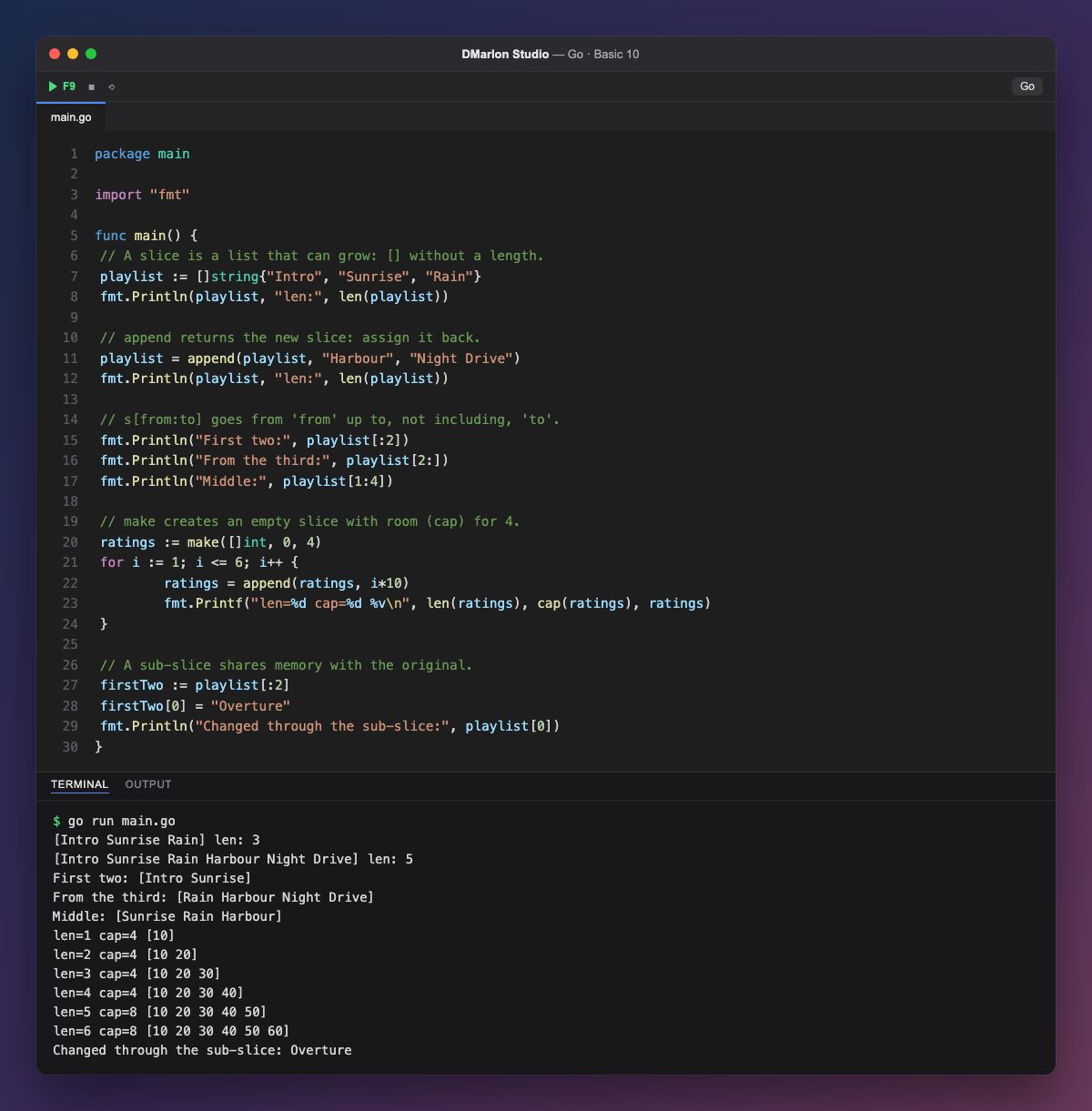
A slice is like an array without a fixed length: []string{...} is written with no number between the brackets. It is the most used list in Go, and len(playlist) tells you how many elements it has: 3.
append adds one or more elements at the end and returns the resulting slice, which you must store again: playlist = append(playlist, ...). If you do not assign it, the change is lost.
playlist[from:to] takes a slice of the slice: from position from up to the one before to. Leave out the first and it starts at 0 ([:2]); leave out the second and it runs to the end ([2:]). [1:4] gives elements 1, 2 and 3.
Under the hood, a slice uses an array with spare room: its capacity, cap. make([]int, 0, 4) creates an empty slice with room for 4. While there is room, append uses it; at the fifth element it no longer fits, so Go creates a bigger array (here of 8) and copies the data across.
A sub-slice is not a copy: it shares memory with the original. Changing firstTwo[0] also changes playlist[0], which becomes Overture. If you need an independent copy, use copy or append the elements to a new slice.
Code · main.go
package mainimport "fmt"func main() { // A slice is a list that can grow: [] without a length. playlist := []string{"Intro", "Sunrise", "Rain"} fmt.Println(playlist, "len:", len(playlist)) // append returns the new slice: assign it back. playlist = append(playlist, "Harbour", "Night Drive") fmt.Println(playlist, "len:", len(playlist)) // s[from:to] goes from 'from' up to, not including, 'to'. fmt.Println("First two:", playlist[:2]) fmt.Println("From the third:", playlist[2:]) fmt.Println("Middle:", playlist[1:4]) // make creates an empty slice with room (cap) for 4. ratings := make([]int, 0, 4) for i := 1; i <= 6; i++ { ratings = append(ratings, i*10) fmt.Printf("len=%d cap=%d %v\n", len(ratings), cap(ratings), ratings) } // A sub-slice shares memory with the original. firstTwo := playlist[:2] firstTwo[0] = "Overture" fmt.Println("Changed through the sub-slice:", playlist[0])}Output · go run main.go
[Intro Sunrise Rain] len: 3
[Intro Sunrise Rain Harbour Night Drive] len: 5
First two: [Intro Sunrise]
From the third: [Rain Harbour Night Drive]
Middle: [Sunrise Rain Harbour]
len=1 cap=4 [10]
len=2 cap=4 [10 20]
len=3 cap=4 [10 20 30]
len=4 cap=4 [10 20 30 40]
len=5 cap=8 [10 20 30 40 50]
len=6 cap=8 [10 20 30 40 50 60]
Changed through the sub-slice: Overture
Key points
[]type{...}creates a slice;lengives its elements.s = append(s, x): always keep what it returns.s[a:b]goes fromatob-1;[:b]and[a:]are shortcuts.make([]T, len, cap)sets aside room;capshows it.- A sub-slice shares memory with its slice.
Exercise
Create a slice with the marks 7, 4, 9, 6 and add 8 with append. Print the middle three with slicing and then the sum of them all with a classic for.